



The "Free" Hardware Trap: Why Free Device Offer Could Cost Your Logistics Fleet Thousands? (Deactive)


Prefer listening? Press play below to hear the AI-generated podcast version of this article.
Imagine this scenario: Your procurement manager comes to you with excellent news. A new telematics vendor is offering to take over your fleet's GPS tracking. Their monthly subscription fee is 20% lower than your current provider, and the best part? They are providing all the tracking hardware completely for free.
On paper, transitioning from Provider A to Provider B looks like a massive financial win with zero downsides. However, decisions like these are often made by managers looking strictly at monthly operational expenditures (OPEX), completely missing the broader strategic picture.
In the world of B2B telematics and Hardware-as-a-Service (HaaS), "free" is rarely free. It is a strategic mechanism designed to lock you in. By the time the hidden costs of cheap hardware and complex migrations surface, the initial 20% savings have already evaporated.
Here is why business owners and fleet directors need to look beyond the initial price tag and understand the Total Cost of Ownership (TCO).
The Disconnect: Procurement vs. Reality
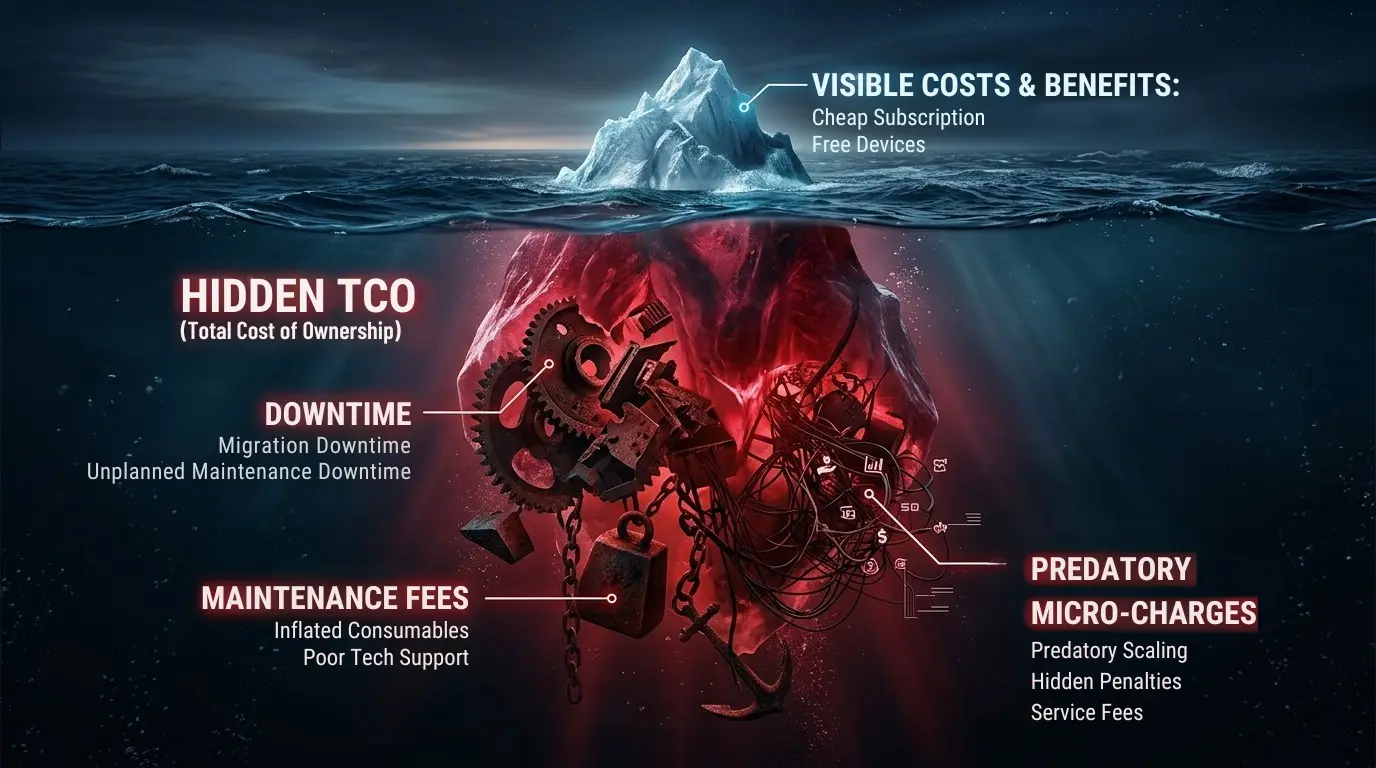
When evaluating a service provider, the monthly subscription fee is just the tip of the iceberg. According to industry frameworks on IoT Total Cost of Ownership (TCO) outlined by connectivity experts at Wireless Logic, initial hardware costs represent only a fraction of true expenses. Unplanned downtime, maintenance, and restrictive support models cause long-term costs to spiral.
Enterprise IT advocacy groups (like Cigref) frequently warn against the "Iceberg Effect" in subscription models. When you accept highly subsidized, cheap hardware, you are building your fleet's visibility on a very fragile foundation.
The Real Cost of Migration: A Logistics Example
Let’s quantify the hidden costs using a realistic example. Suppose you run a distribution company with a fleet of 50 delivery vehicles. You decide to switch to a cheaper provider to save $1,000 a year on subscription fees.
Transitioning isn't just about plugging in a new device. First, Provider A must physically demount their proprietary hardware, often charging a premium "de-installation fee." Then, Provider B's technicians must wire the new devices. Each of your 50 distribution vehicles must be pulled off the road twice.
If a distribution van generates $50 of revenue per hour, losing just 2 hours of operational time per vehicle (1 hour for demounting, 1 hour for installation) costs $100 per van. For a fleet of 50 vehicles, that is $5,000 in lost revenue—five times your projected annual savings! Keep in mind, this represents the absolute minimum time lost, assuming perfect logistical planning and zero technical problems. Add in the de-installation invoices from Provider A, and your "cheap" transition becomes a massive financial liability.
Death by a Thousand Cuts: The Micro-Charge Trap

Because the vendor makes zero profit on the "free" hardware and very little on the discounted subscription, their business model relies on monetizing every subsequent interaction. Once the contract is signed, the hidden invoicing begins:
- The "Faulty Asset" Trap: When their cheap tracker inevitably fails due to poor manufacturing, the provider will frequently blame external factors—such as "vehicle electrical surges" or "negligent use." They use this loophole to void the warranty and charge you premium repair fees for a device you don't even own.
- Inflated Consumables: While the tracker replacement might technically be "free," the replacement of cables, connectors, or burnt fuses is billed at 300% to 500% above market value.
- On-Site Maintenance Fees: You may be charged unexpected repair and service fees during on-site maintenance visits, even when the hardware failure or maintenance requirement wasn't your fault.
- Regional Dispatch Logistics: If your truck requires maintenance while operating in regions of Azerbaijan outside the capital, the provider will hit you with exorbitant travel and per-diem logistics invoices for their technicians to come and fix their own faulty hardware.
- Asset Liquidation Penalties: If you decide to sell or retire a vehicle from your fleet, you cannot simply hand it over to the buyer. You are forced to pay a hefty "safe demounting" fee just to return the "free" tracker to the vendor.
Predatory Scaling (The Hook & Line)
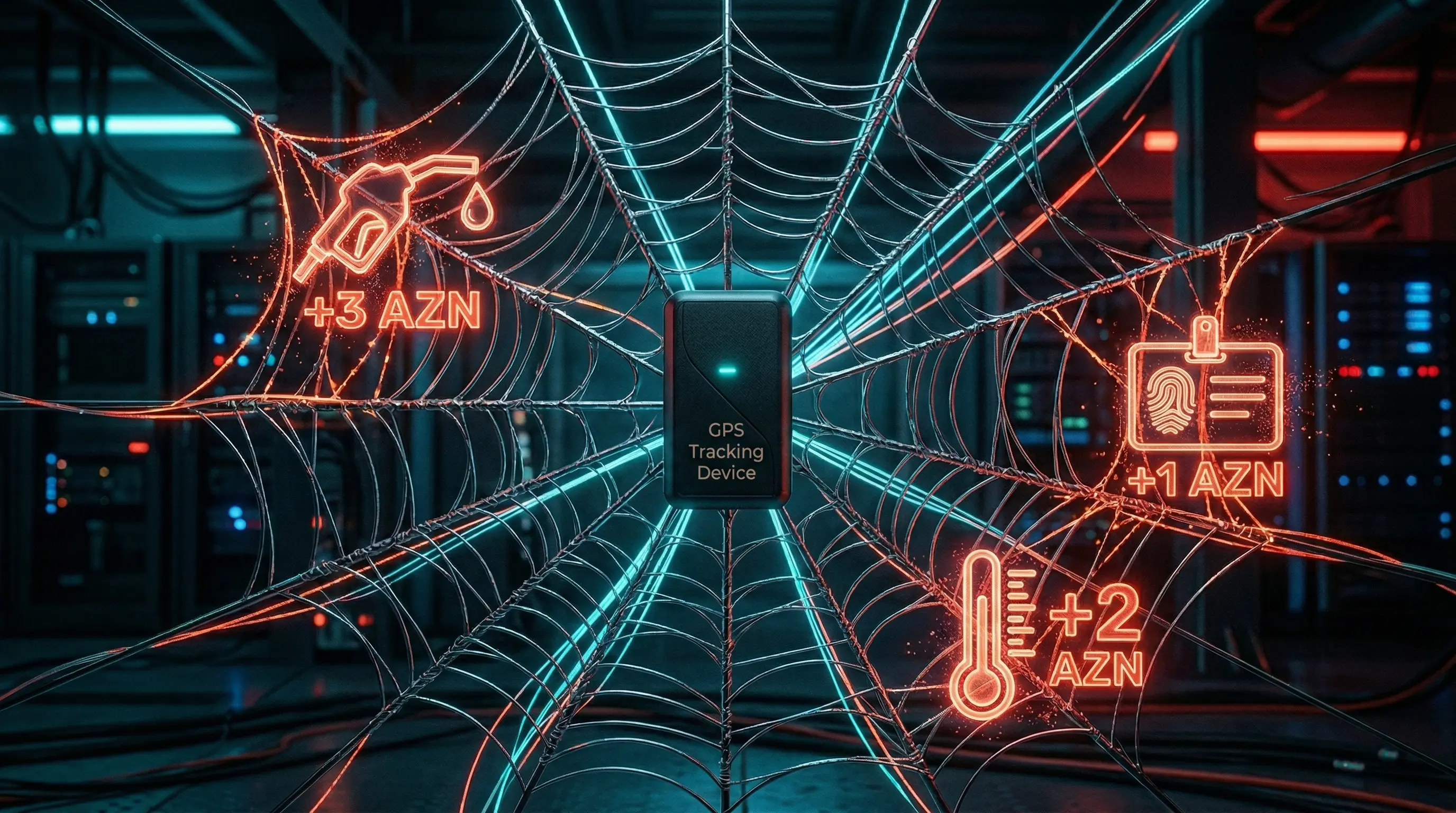
Perhaps the most insidious trap is the cost of scaling. You might start with a basic GPS tracker, but eventually, your logistics operations will require advanced data: fuel level sensors, temperature probes, or driver identification.
The vendor knows that tearing out the existing hardware to switch companies is too painful for you. Because you are already "on the hook," the monthly subscription fee for adding these basic peripheral sensors increases disproportionately compared to fair market rates.
The Support Deficit & Degradation of Service
Quality customer support is an operational expense that requires healthy profit margins. If a vendor is slashing subscription fees to absolute minimums to capture market share, the math dictates that they must cut costs elsewhere. That "elsewhere" is almost always customer service.
Over time, you will notice a severe degradation in the quality of service. You will experience longer SLA response times, support desks with no technical authority, and a complete lack of proactive system maintenance. When a critical device stops transmitting data—leaving your vehicle "blind" and compromising cargo security—your urgent requests are placed at the bottom of the queue.
The Strategic Advantage of Premium Hardware
The alternative to the "free hardware" trap isn't necessarily just paying more upfront; it is about investing in agility. Whether you purchase premium European hardware or enter a transparent agreement for high-quality devices, you secure two major advantages:
- Decade-Long Reliability: Premium devices are engineered to run flawlessly for 10 years and more, completely eliminating the operational headaches of constant maintenance, rapid degradation, and false "vehicle power surge" claims.
- Zero Vendor Lock-In: When you own high-quality, unlocked hardware, you are free. If you are unsatisfied with your software platform, you don't need to ground your fleet, pay de-installation fees, and rip out the wiring. You simply redirect the IP address of your existing premium trackers to a new telematics platform remotely.
How to Protect Your Fleet
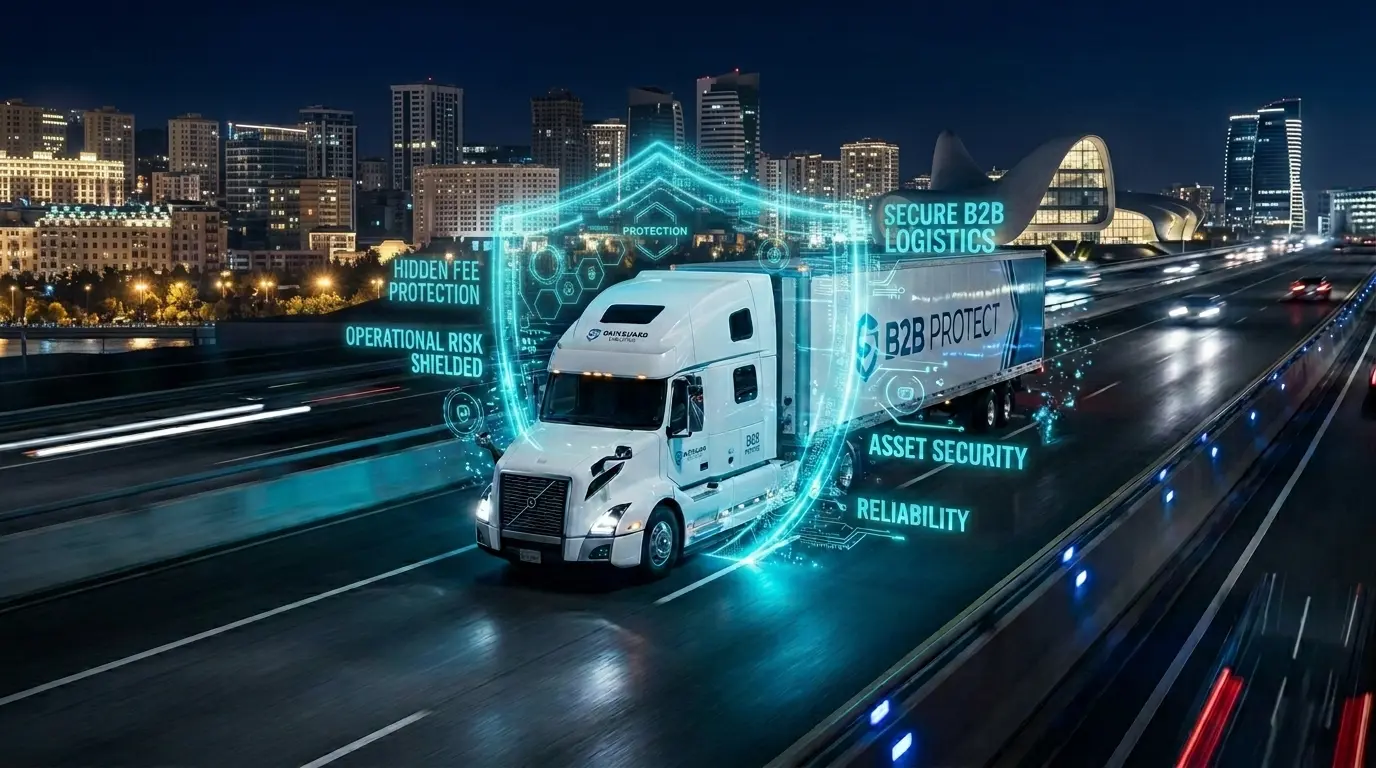
To avoid the hidden pitfalls of race-to-the-bottom telematics contracts, adopt a defensive approach to procurement:
- Scrutinize the Exit Strategy: Calculate the exact cost of leaving. Are there hidden de-installation fees when you sell a truck?
- Demand a Strict SLA: Your contract must legally guarantee response times and include financial compensation for vendor-caused downtime.
- Define Maintenance Inclusions: Protect yourself from the micro-charge trap by ensuring the contract explicitly lists what is covered. Negotiate fixed caps on consumables, diagnostic fees, and regional dispatch costs so you aren't hit with inflated invoices for minor repairs.
- Pre-Negotiate Scaling Costs: Don't wait until you need fuel sensors or temperature probes to ask for the price. Lock in a standardized rate card for future peripheral integrations and software upgrades at the beginning of your contract to avoid predatory price hikes once you are dependent on the platform.
- Focus on Value, Not Just Price: A premium device running reliably for a decade is infinitely cheaper than a "free" device that disrupts your delivery schedules every quarter and bleeds your budget through micro-charges.
Ultimately, B2B telematics providers are for-profit enterprises, and true "free" hardware simply does not exist. If the hardware is subsidized, the cost is merely hidden in your future operational risks and micro-charges. By shifting your focus from the lowest monthly OPEX to long-term operational reliability, you protect your bottom line, maintain your fleet's agility, and keep your business running smoothly
🎁 Free PDF Checklist: How to Avoid the "Free Hardware" Trap
Preparing to sign a new telematics or GPS tracking contract? Protect your fleet from hidden fees, forced downtime, and vendor lock-in with our expert-crafted 12-Point Vendor Evaluation Checklist.
This document will arm you with the right questions to ask, ensuring you secure a transparent, zero-lock-in agreement. Simply enter your name and email in the form below to receive the PDF checklist instantly in your inbox.


Stay Connected! 🛰️ Follow A+A Security for the latest insights in fleet management and GPS technology. Your support helps us grow!


